A few words on the European Accessibility Act
People were not prepared: insert surprise Pikachu face here
How it all started
The long awaited coming of the EAA
The European Accessibility Act is a sweeping directive by the European Union requiring online and physical products and services to comply with specific accessibility rules.
The goal of the directive is to remove the barriers preventing over 100 million Europeans with disabilities from accessing e-commerce websites, banking apps, media platforms and other online services by forcing any private company (with some exemptions) to follow a list of guidelines called WCAG 2.1 AA.
The EAA was approved in 2019 and came into full effect six years later, in June 2025, leaving many flabbergasted.
The EAA was approved in 2019 and came into full effect six years later, in June 2025, leaving many flabbergasted.

What's in the EAA?
At its core, the European Accessibility Act takes the familiar WCAG rules and makes them a legal requirement. In practice, this means things like alt text for images, captions for video, proper colour contrast, and websites that work with a keyboard as well as a mouse. Content should be easy to read, forms need clear labels and error messages, and pages must work smoothly with screen readers or other assistive tech.
The law also zooms in on certain industries: shopping and checkout flows in e-commerce, mobile and online banking, video platforms, and even ticketing for transport must all be accessible from start to finish. Any company with more than 10 staff and more than €2 million in turnover is required to comply or face fines and walk the UX walk of shame. This includes US companies operating in the EU.
The law also zooms in on certain industries: shopping and checkout flows in e-commerce, mobile and online banking, video platforms, and even ticketing for transport must all be accessible from start to finish. Any company with more than 10 staff and more than €2 million in turnover is required to comply or face fines and walk the UX walk of shame. This includes US companies operating in the EU.
Bol.com accessibility audit
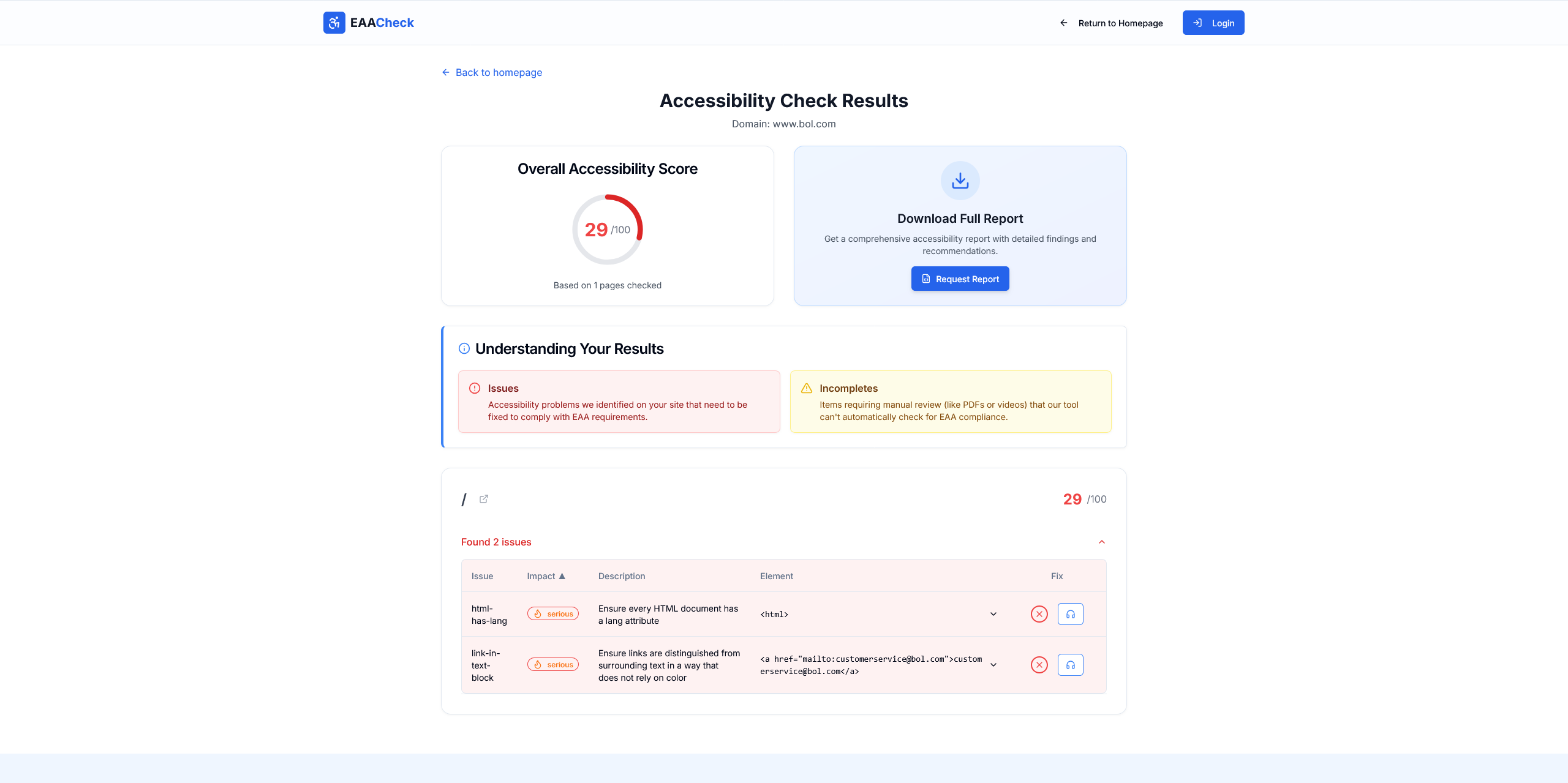
There are many tools online able to audit a webpage, mostly built with the goal of terrorizing people into buying an expensive audit. Nevertheless, the results for bol.com home page are quite underwhelming.
The box-ticking game
In reality, no one forgot about the Accessibility Act and, if they did, it was because they either did not care or did not know. For a long time, accessibility has been treated like a box-ticking exercise, under the wrong assumption that tweaking the contrast on a button a little would be enough to make a website usable for a broader audience. Compliance has always been about meeting the minimum requirement, not ensuring an equitable experience. As the accessibility expert Sheri Byrne-Haber put it: "Compliance is a checkbox. Inclusion is a mindset".
Real accessibility means considering people with disabilities from the outset, not as an afterthought.
Sheri Byrne-Haber
There's more then one piece of evidence, too. An audit of 317 Dutch retail stores in 2024 found out a plethora of accessibility issues still lingering a few months before the official deadline of June 2025: insufficient contrast, links with no descriptive names, and lack of alt text, to name a few. These were not occasional mistakes but common practice in the industry In 2023, De Nederlandsche Bank reported that one in six adults in the Netherlands can't do banking on their own: among those, apart from the damn expats and their lack of language proficiency, people with difficulty operating the banking app.
Pointing some fingers
To be fair, this is my fault. It is my fault as much as it is our fault, as much as it is everybody’s fault.
It is my fault because as a designer I am guilty of chasing the wow effect, and it is the industry’s fault because that wow effect is valued over accessibility. It is my fault as a UX designer because I should honestly know better and advocate for best practices whenever possible, but it is the industry’s fault too: we have all been part of the grind, of that backlog that never seems to end, and as priorities shift, accessibility never makes it to the top.
It is my fault because as a designer I am guilty of chasing the wow effect, and it is the industry’s fault because that wow effect is valued over accessibility. It is my fault as a UX designer because I should honestly know better and advocate for best practices whenever possible, but it is the industry’s fault too: we have all been part of the grind, of that backlog that never seems to end, and as priorities shift, accessibility never makes it to the top.

Name and shame
While I did spent countless hours perfectly matching the dark blue of the background with the soft sand color of the title, what I sometimes forget is to make things easy to read. This is a screenshot from a previous personal portfolio.
But what if it's GDPR all over again?
I remember when GDPR regulations came into existence. I remember the terror and pain of those days, the first cookie consent banners appearing, multiplying, and then everybody racing to find workarounds to keep collecting personal data.
Do you want to keep reading that article? Well, you had better be prepared to give up some of your privacy.
Will you accept this handpicked selection of totally trustworthy partners? Profiled advertising is better for you!
Do you want to keep reading that article? Well, you had better be prepared to give up some of your privacy.
Will you accept this handpicked selection of totally trustworthy partners? Profiled advertising is better for you!
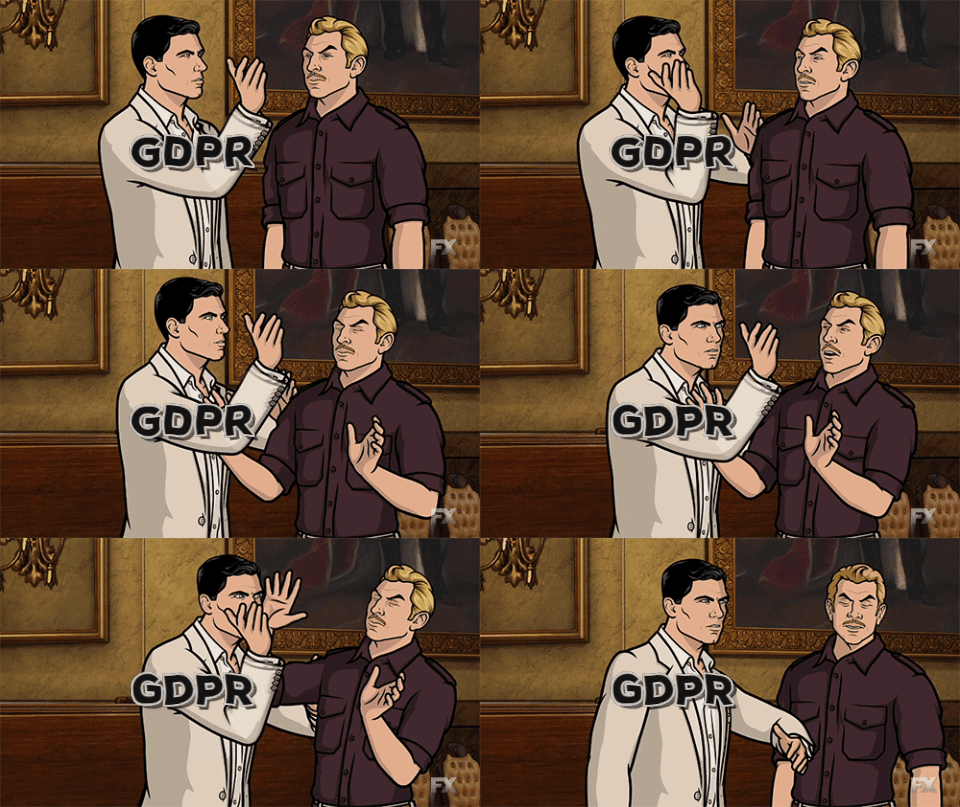
If there is one thing that GDPR taught me, it is that laws and regulations do not magically solve a problem, nor does enforcement, because once again it becomes just a matter of checking boxes.
While I do consider privacy important, and to this day manually refuse every single cookie, I think this time it is necessary to shift the mindset of how we operate from the ground up. Accessibility rules should become part of how we build digital experiences, not just another imposition from our friends in Brussels or another GDPR moment.
Despite the challenges, I am hopeful that the European Accessibility Act will spark positive change, not only because it requires compliance, but because it might finally shift mindsets in the tech and design community. There are already signs that doing the right thing can also be good for business: when websites are made accessible, all users benefit from clearer interfaces, better structure, and more versatility in how content is consumed.
As for me, I will still make mistakes on this little online space of mine, but this time I will not blame them on anyone but myself and on the destiny of any designer’s personal project: like the plants we forget to water, they are always a bit wild and never perfectly trimmed.
While I do consider privacy important, and to this day manually refuse every single cookie, I think this time it is necessary to shift the mindset of how we operate from the ground up. Accessibility rules should become part of how we build digital experiences, not just another imposition from our friends in Brussels or another GDPR moment.
Despite the challenges, I am hopeful that the European Accessibility Act will spark positive change, not only because it requires compliance, but because it might finally shift mindsets in the tech and design community. There are already signs that doing the right thing can also be good for business: when websites are made accessible, all users benefit from clearer interfaces, better structure, and more versatility in how content is consumed.
As for me, I will still make mistakes on this little online space of mine, but this time I will not blame them on anyone but myself and on the destiny of any designer’s personal project: like the plants we forget to water, they are always a bit wild and never perfectly trimmed.